Professor and investigation
Welcome to the passion for history!
Welcome to a journey through time! History is not limited to dates and events; it is a vibrant tapestry of stories, cultures, and ideas that have shaped our world. Whether you are a curious explorer or an experienced scholar, I invite you to immerse yourself in fascinating narratives, discover surprising connections, and appreciate how the past continues to inspire our future. Join me in exploring the legacy of human experience and the unending passion for history that unites us all.
Academic work
My academic background combines a solid historical training with pedagogical and linguistic specialization. I began my studies with a Bachelor's Degree in History at the University of Granada (2014-2019), where I perfected my skills in research and analysis of sources - with emphasis on Paleography, Diplomacy and US History - and defended a Final Degree Project on the landscape of the Soto de Roma and its surroundings from the thirteenth to the twentieth century, obtaining outstanding grades. I then took the EURAME Master's degree at the same university (2019-2020), in which my final paper, rated 9.5, was recognized as a solid starting point for a doctoral thesis. Between 2021 and 2022 I completed the Master in Teacher Training at the International University of Valencia, acquiring proficiency in didactic methodologies and educational planning. Currently, I am expanding my skills in critical analysis of texts and linguistic structures in the M.A. in Spanish Linguistics and Literature at Auburn University (2024-2026).
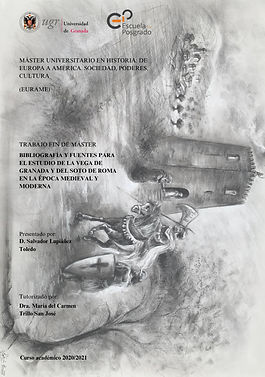
2020 Master's Thesis
Bibliography and sources for the study of the Vega of Granada and the Soto of Roma in Medieval and Modern times.
The aim of this work is to analyse the historical evolution of the landscape, as well as to understand the land use and the societies that inhabited and worked the land. and the societies that inhabited and worked the lands of the Vega de Granada, especially those of the Soto de Roma. the Vega de Granada and especially those of the Soto de Roma. The study will be carried out from the from the end of the ancient world to modern times, with particular emphasis on the medieval period. medieval period.
The aim of this work is to carry out a bibliographical study and a study of the historical and archaeological sources that have reached the and archaeological sources, which have reached us up to the present day and which will allow us to learn about the the historical, social and landscape evolution of the Vega de Granada, with particular interest in the Soto de Roma and the of special interest in the Soto de Roma and its surroundings. The aim of this Master's thesis is also to make diverse historical material available for future historical research.

2020 Degree's Thesis
The landscape in the Soto de Roma and in the surroundings of the Torre de Roma, from the 13th to the 20th century.
What I intend with this work is to create in the reader an image, as clear as possible, about the landscape, which over the centuries has surrounded the Tower of Rome. A landscape that, as you can see, has been changing, it has not remained static from one century to another, not even from half a century to half a century.
Therefore, the reason why I am carrying out this work is because no one had ever before carried out a study on the landscape around the Tower of Rome throughout its history, from its construction to the present day, and also to be able to verify the different uses of the soil in this part of the fertile plain and the different crops.
The choice of the environment of the Tower of Rome is determined by several factors such as the lack of historical research work on the environment surrounding the Tower of Rome and all this area of the plain from its construction to the present, the need to focus more on how the landscape of the plain has changed throughout history.
In this work by Luis Martínez we can see the visibility from the Tower of Rome to the entire surrounding landscape. Below in a map made by me we will be able to see the area of study within the vega of Granada on which I have focused, as well as the main population centers mentioned throughout the work and the most important areas.

Project Proposal
At Auburn University, I have conducted several research projects, both in literature and history, which I show below and which are awaiting publication:
Corona de sombra: ¿Un intento de benevolizar la figura de Maximiliano I de México?
Corona de sombra: An attempt to benevolize the figure of Maximilian I of Mexico?
This article investigates in depth how Rodolfo Usigli portrays Maximilian I of Mexico in his play Corona de sombra, using a discursive analysis based on the principle of specificity. Throughout the play, Usigli handles language in such a way that he seems to try to project in the reader/viewer an image of Maximilian different from the one that predominates in the Mexican historical imaginary about the Second Empire. Maximilian and Carlota represented a turning point in Mexican history, standing between the Second Federal Republic and the Restored Republic. This paper seeks to demonstrate, through the analysis of the discourse used by Usigli in Corona de sombra, how the author benevolized the figure of the emperor in the mid-twentieth century through the discourse used in the play.
Una aproximación al paisaje del pasado andalusí y nazarí granadino. La Vega de Granada y el Soto de Roma del siglo X al XV d. C.
An approach to the landscape of Granada's Andalusian and Nasrid past. The Vega of Granada and the Soto de Roma from the 10th to the 15th century AD.
The aim of this research is to make an approach to the landscape of the Vega of Granada, and specifically to the Soto de Roma, through the narrative sources of Arab authors. This work also includes the use of agriculture as a transforming element of the landscape, as well as the societies that worked it. The focus is on Arab narrative sources due to the amount of documentation available to study the historical, social and landscape evolution of the region. In addition, a bibliographic analysis of the historical sources that allow understanding these aspects will be offered, to provide valuable historical material for future research. A toponymic compilation of the population centers of this area and their historical evolution is also carried out, which will serve to know the fixation of the people to the territory throughout the centuries.
Trafalgar vs Cabo Trafalgar. Un acontecimiento histórico que marcó el valor nacional (oficiales vs vulgo)
Trafalgar vs Cape Trafalgar. A historical event that marked the national valor (officers vs. commoners).
The purpose of this article is to compare the works of two great authors, Trafalgar, by Benito Pérez Galdós and from the 19th century, and Cape Trafalgar, by Arturo Pérez-Reverte and from the beginning of the 21st century. It is unquestionable that the work of Perez Reverte drinks, and is absolutely influenced by the work of Galdós, but both treat the historical event from a different perspective and put in value different social “estates”. Through this work we intend to confront the vision of Benito Pérez Galdós in whose work (Trafalgar) he presents the officers of the national ships as heroes (as opposed to the shame of the French allies) against the image projected by Arturo Pérez Reverte in his work Cape Trafalgar, placing value on the common people, the people, forced to fight in a battle that they did not ask for, that did not “belong” to them, and who put unquestionable courage in the heat of battle. This is intended to show the vision, comparatively, that both have of the high commanders of the army who participated in the battle and of the people recruited in haste to be sailors and how, through them, the government of the time is shown. The purpose is to show the differentiated vision that both authors had of the time they narrate, taking into account the different historical moments in which they write.